 Cosmic Scale
: universe, space and planets size comparison in 3D
Universe size comparison in 3D: explore space and see how big planets, stars, black holes and galaxies really are, side by side at true scale.
Get it on Google PlayFree · Android · 15 languages
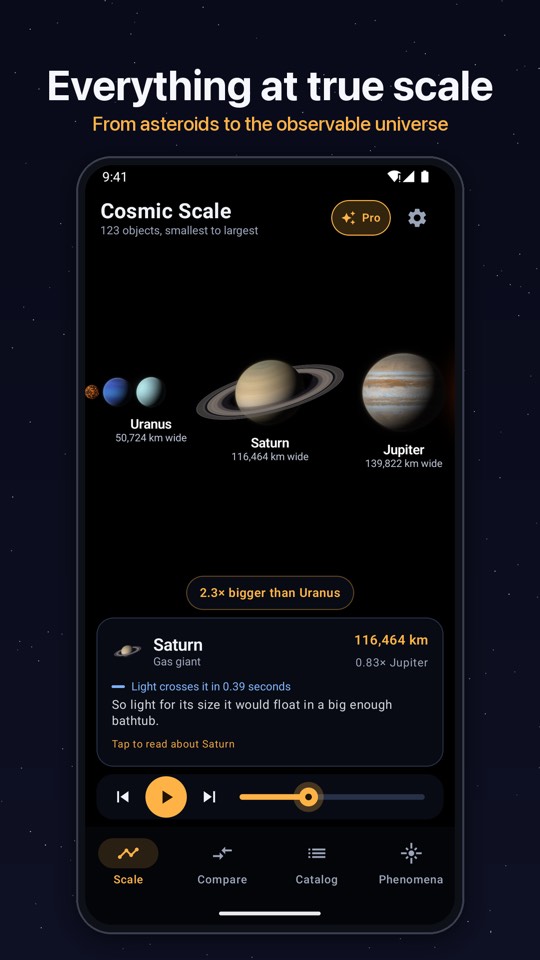
Fly from a small asteroid to the edge of the observable universe and feel how big the cosmos is.
How big is the Sun next to Earth? How small is the Sun next to the largest stars? What does a black hole do to a star that comes too close? And where are we, inside the Milky Way and beyond?
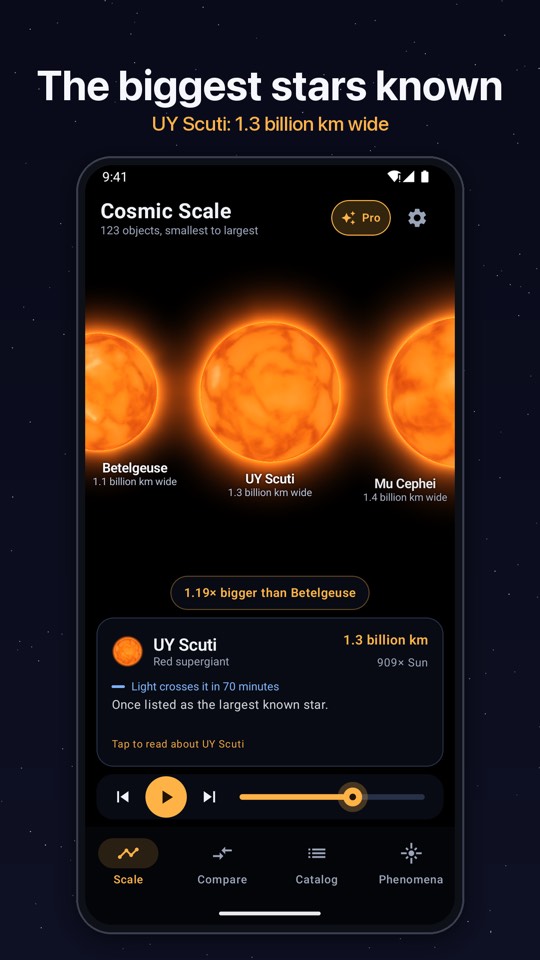
Cosmic Scale lines up 77 objects from smallest to largest, from a 490-metre asteroid to the Solar System and the Oort Cloud, and 179 with the Beyond pack, which adds galaxies, nebulae and the largest structures in the cosmos. Every one is drawn at its true size, so it is a planet, star and black hole size comparison in one: a 3D solar system and beyond.
Sizes by category
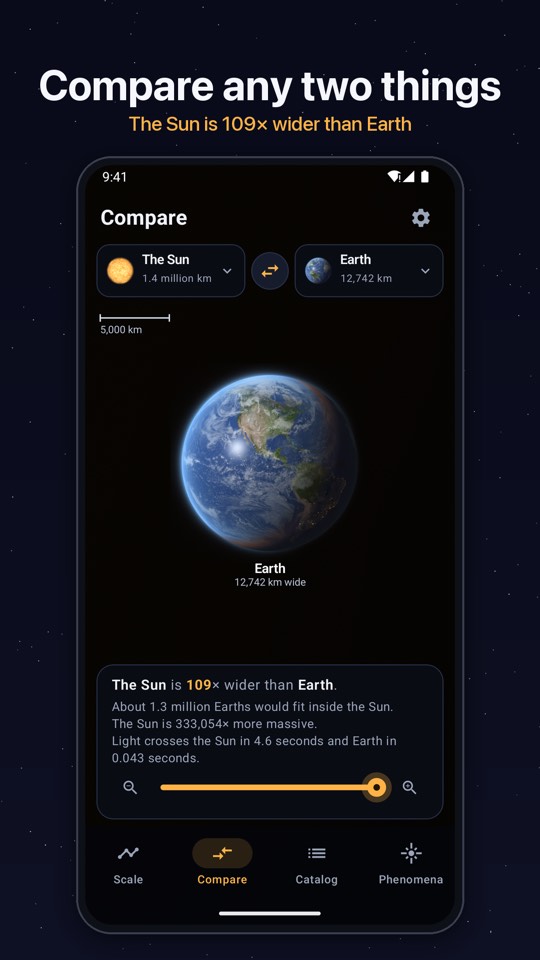
COMPARE ANY TWO
"The Sun is 109× wider than Earth. About 1.3 million Earths would fit inside it. Light crosses it in 4.6 seconds." Pick any two objects and see them side by side at real scale.
37 SPACE SIMULATIONS
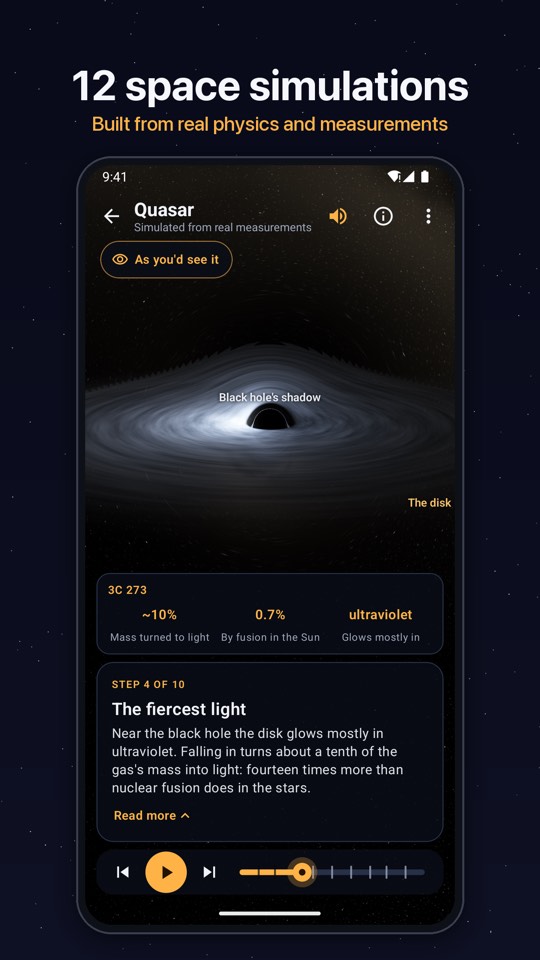
Cosmic Scale is also a space simulator. 21 simulations show what really happens in space, step by step, with real numbers and real physics: a pulsar, the Sun's death, a black hole tearing a star apart, a supernova, colliding neutron stars, comet Shoemaker-Levy 9 hitting Jupiter, the asteroid that ended the dinosaurs, how a star is born, S301, the fastest star round our galaxy's black hole, the Big Bang and more. 16 What ifs follow the theory where no one has looked: Earth that stops spinning, Earth with a ring, a space elevator, the Sun as a black hole, wormholes. Anything no eye could see is drawn and labelled as drawn.
ASK ABOUT SPACE
A space guide answers your questions about planets, stars and spaceflight.
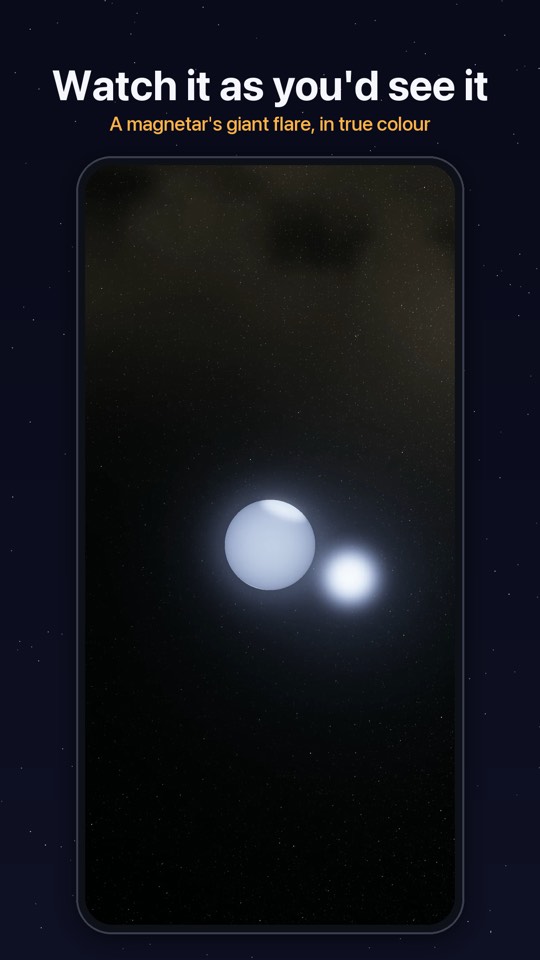
AS YOU'D SEE IT
Ten simulations also play as a short film of only the light your eyes would catch, in true colours, with nothing drawn over it.
SKY: WHAT IS ABOVE YOU TONIGHT
See tonight's Moon and bright planets in the night sky, plus the eclipses, meteor showers and planet meetings coming up this year, worked out on your phone from real orbits, no telescope needed. Get a note the evening before something worth looking up for (you can switch it off in Settings), and add your location to see which eclipses you can see.
THE TOUR
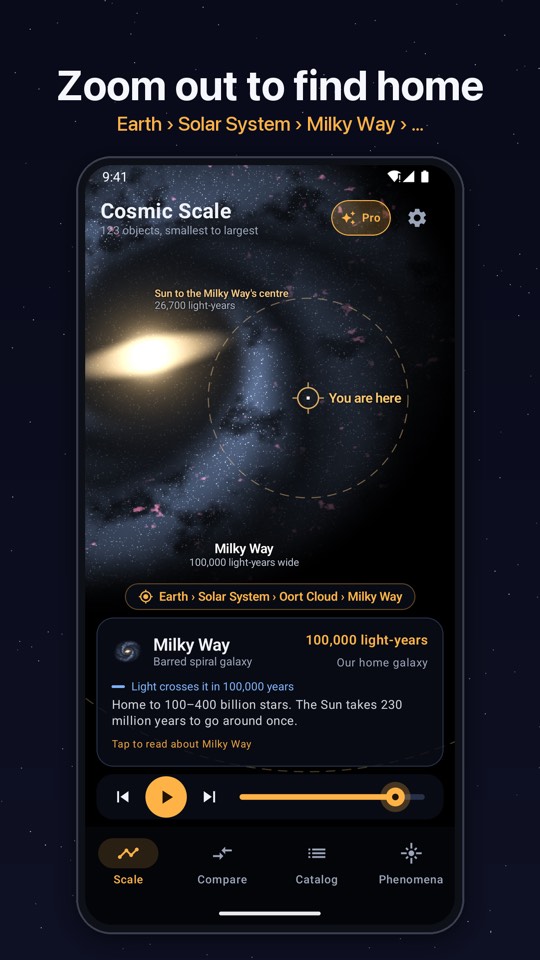
Press play and fly from an asteroid past moons, planets, stars and black holes out to the observable universe, with calm music and a bell for every step up in size. At each layer we live inside, the tour dives in to show where we are: Earth in the Solar System, the Solar System in the Milky Way, all the way out.
INSPECT ANYTHING IN 3D
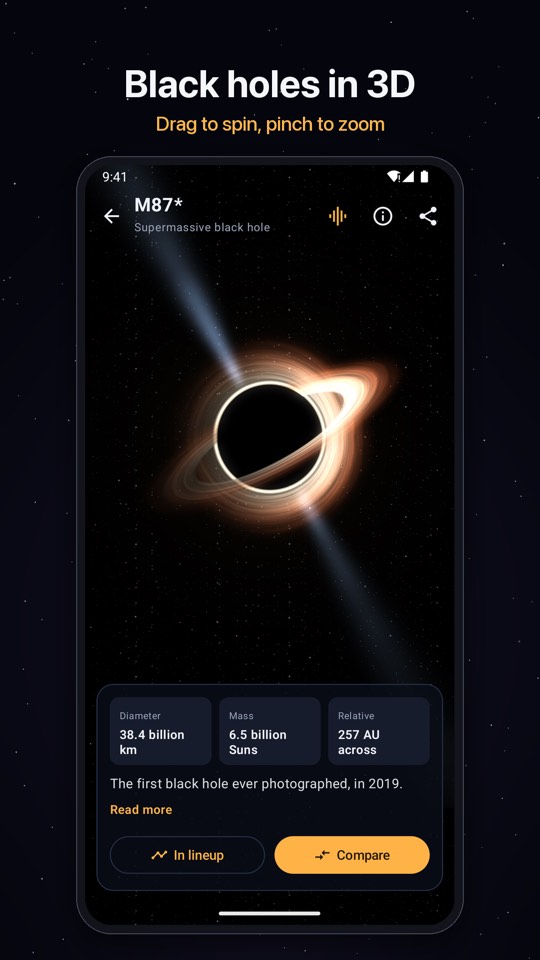
Turn any object with your finger: tilt Saturn's rings, spin a galaxy edge-on, look down onto a black hole's glowing disk, and share a picture.
REAL MAPS, PHOTOS AND SOUNDS
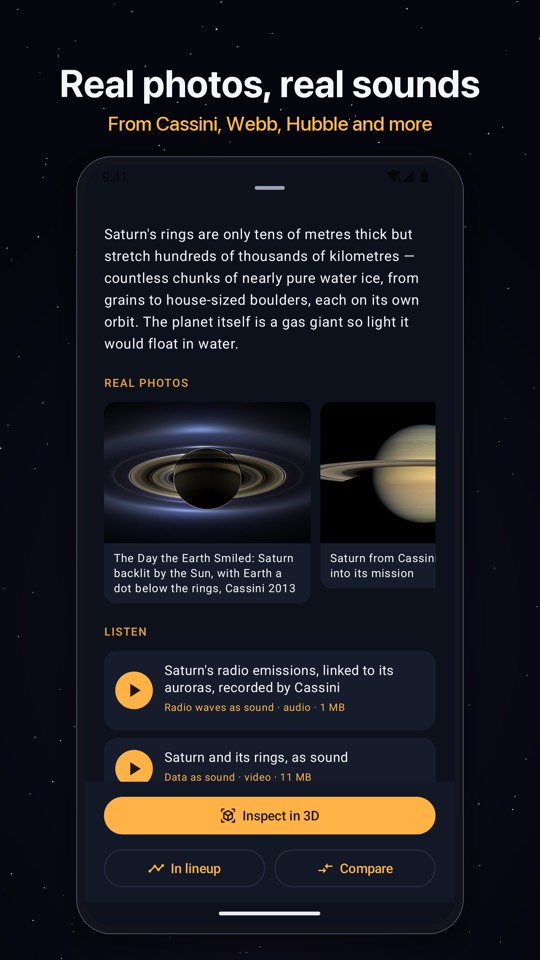
Planets and moons wear real maps from NASA missions. Open any object for real photographs, from the Blue Marble to Webb's deep fields, each credited. Listen to the wind on Mars, lightning on Jupiter, Saturn's radio auroras and NASA's sonifications of black holes.
15 LANGUAGES
English, Español, Português, Français, Deutsch, Türkçe, Bahasa Indonesia, Tiếng Việt, Русский, Oʻzbekcha, العربية, हिन्दी, 简体中文, 日本語 and 한국어.
FREE, WITH OPTIONAL VIDEOS
Every simulation opens for 24 hours with one short video, and so do the Beyond pack and Ultra graphics. Ads appear only at natural breaks, never inside a simulation.
COSMIC SCALE PRO
No ads, ever, and everything open at once: all 179 objects, every simulation and film, and Ultra graphics. $25 a year, $3 a month, or $35 once for life. Subscriptions renew until you cancel them in Google Play. No sign-up needed: Pro stays with your Google account.
Questions
How big is the Sun compared to Earth?
The Sun is about 109 times wider than Earth: 1,391,000 km against 12,740 km. About 1.3 million Earths would fit inside it.
How big is Jupiter compared to Earth?
Jupiter is about 11.0 times wider than Earth (139,800 km across). More than 1,300 Earths would fit inside it.
How big is the Moon compared to Earth?
Earth is about 3.67 times wider than the Moon, which is 3,475 km across.
What is the biggest star in Cosmic Scale?
Stephenson 2-18, about 3.0 × 10⁹ km across: roughly 2,150 Suns side by side. Stars this large are uncertain by tens of percent.
How big is a black hole?
The size of a black hole is the size of its event horizon, the point of no return. For Sagittarius A*, at the centre of the Milky Way, it is about 2.5 × 10⁷ km across. For the giant TON 618 it is about 0.04 light-years.
Is Cosmic Scale free?
Yes. The pulsar simulation is free. Each other simulation opens for good with one short video, and the Beyond pack and Ultra graphics open for 24 hours with a video. Ads appear only at natural breaks, never inside a simulation. Cosmic Scale Pro removes the ads and opens everything: $25 a year, $3 a month or $35 once.
Which languages does Cosmic Scale speak?
English, Español, Português, Français, Deutsch, Türkçe, Bahasa Indonesia, Tiếng Việt, Русский, Oʻzbekcha, العربية, हिन्दी, 简体中文, 日本語 and 한국어.
Explore the objects
Planets
Moons
- Deimos
- Phobos
- Mimas
- Miranda
- Enceladus
- Tethys
- Dione
- Charon
- Iapetus
- Oberon
- Rhea
- Titania
- Triton
- Europa
- The Moon
- Io
- Callisto
- Titan
- Ganymede
Dwarf planets
Asteroids & comets
Exoplanets
Stars
- TRAPPIST-1
- Proxima Centauri
- Barnard's Star
- Epsilon Eridani
- Alpha Centauri B
- The Sun
- Alpha Centauri A
- S301
- Sirius
- Vega
- S2
- Spica
- Pollux
- Arcturus
- Polaris
- R136a1
- Aldebaran
- Canopus
- Rigel
- Deneb
- Eta Carinae
- Pistol Star
- Rho Cassiopeiae
- Antares
- Betelgeuse
- UY Scuti
- Mu Cephei
- RW Cephei
- Westerlund 1-26
- HR 5171 A
- VY Canis Majoris
- KY Cygni
- WOH G64
- Stephenson 2-18
Stellar remnants
Black holes
- XTE J1650-500
- V404 Cygni
- Gaia BH1
- LMC X-1
- Cygnus X-1
- Gaia BH3
- M32's black hole
- Sagittarius A*
- Andromeda's black hole
- Sombrero's black hole
- M84's black hole
- Cygnus A's black hole
- H1821+643
- NGC 1277's black hole
- M87*
- S5 0014+81
- NGC 4889
- Holmberg 15A*
- TON 618
- Phoenix A*
Solar System
Nebulae & clusters
- Stingray Nebula
- Egg Nebula
- Red Square Nebula
- NGC 3918
- IC 418
- Boomerang Nebula
- Barnard 68
- Saturn Nebula
- Little Ghost Nebula
- Cat's Eye Nebula
- IC 4593
- Lemon Slice Nebula
- Homunculus Nebula
- NGC 7662
- Blinking Nebula
- Ring Nebula
- Ghost of Jupiter Nebula
- Hourglass Nebula
- Oyster Nebula
- Twin Jet Nebula
- Ant Nebula
- Eskimo Nebula
- NGC 2346
- Owl Nebula
- Horsehead Nebula
- Helix Nebula
- Crab Nebula
- Orion Nebula
- Witch Head Nebula
- Messier 4
- Eagle Nebula
- Pleiades
- Omega Centauri
- Messier 2
- Running Chicken Nebula
- Carina Nebula
- Tarantula Nebula
Galaxies
- M60-UCD1
- Segue 2
- IC 10
- Messier 32
- W2246-0526
- Small Magellanic Cloud
- Large Magellanic Cloud
- Messier 82
- Sombrero Galaxy
- Triangulum Galaxy
- Whirlpool Galaxy
- Fireworks Galaxy
- Messier 81
- Milky Way
- Hoag's Object
- Andromeda Galaxy
- Cartwheel Galaxy
- Pinwheel Galaxy
- Comet Galaxy
- Tadpole Galaxy
- Antennae Galaxies
- Condor Galaxy
- Malin 1
- Hercules A
- ESO 383-76
- IC 1101
- Alcyoneus
- Porphyrion
Cosmic structures
Get it on Google PlayFree · Android · 15 languages