 Cosmic Scale
What if Jupiter became a star?
Jupiter given the mass of the smallest stars: how it would look, why its moons would fall in, and what its pull would do to the asteroids and the planets
A what-if: physics allows it on paper, but no one has ever seen one. Everything shown follows the theory as it stands.
Step by step
The biggest planet
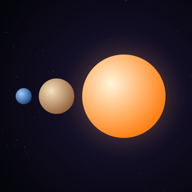
Jupiter weighs more than twice as much as all the other planets put together. It is made of the same stuff as the Sun, mostly hydrogen and helium, which is why it is sometimes called a failed star. It is a poor name: Jupiter formed as a planet, and it is far too light to shine.
The four dots near it are its largest moons, Io, Europa, Ganymede and Callisto, found by Galileo in 1610. Io is the most volcanic world known, and Europa hides an ocean under its ice. Keep an eye on all four.
A red dwarf
Red dwarfs are the smallest stars and the most common: about seven in ten stars in our galaxy are of this kind. Not one can be seen with the naked eye, because they are so dim. TRAPPIST-1 is a real one, 40 light-years away, with seven planets of its own.
A star this small burns its hydrogen so slowly that it would shine for trillions of years, long after the Sun has died. Most of its light is infrared. To the eye it would look deep orange-red, with dark starspots.
What Earth would feel
The danger is the asteroids. The real belt holds more than a million bodies over 1 km across. Sent across Earth's path in such numbers, some would hit, and impacts like the one that ended the dinosaurs would come far more often than they do now. How often, this simple run cannot say.
Could it happen?
Real planets do live with two suns. Kepler-16b circles a pair of stars, and Gamma Cephei has a planet although a red dwarf circles the same star about as far out as Uranus. This story shows why such systems look the way they do: planets close to one star, or far outside both, and nothing in between.
Objects in this story
More simulations
- How the Solar System formed
- T Coronae Borealis: the star about to appear
- S301: the fastest known star
- Comet Shoemaker-Levy 9 hits Jupiter
- The asteroid that ended the dinosaurs
- How a star is born
- Pulsar
- Earth's magnetic shield
- The Sun's death
- A star torn apart
- A massive star explodes
- Type Ia supernova
- How black holes are made
- Two black holes merge
- Two neutron stars collide
- Magnetar
- Quasar
- Gravitational lensing
- The brightest gamma-ray burst
- The Milky Way meets Andromeda
- The Big Bang
What if: ideas no one has observed
- A neutron star skims past Earth
- What if Earth stopped spinning?
- What if Earth had a ring?
- What if we built a space elevator?
- What if the Sun became a black hole?
- False vacuum decay
- What if the Moon disappeared?
- Wormhole
- White hole
- Warp drive
- Dyson swarm
- Hawking evaporation
- Near light speed
- Falling into a black hole
- A black hole crosses the Solar System